


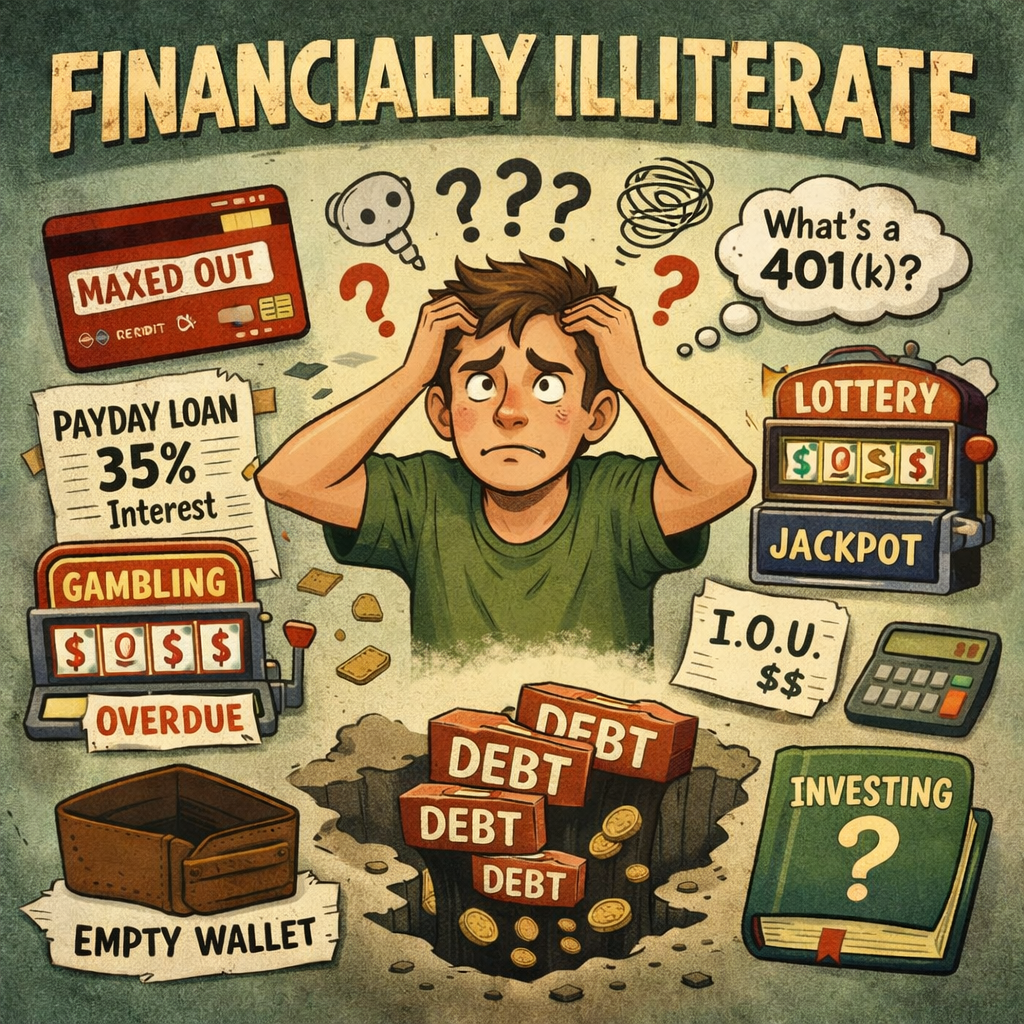


Most Americans don’t have a thousand dollars saved and are up to their eyeballs in debt. Yet, many still scoff at the idea of receiving help from a financial coach. They’re too proud to admit that they need financial literacy. I was one of those people. But I graduated with two finance degrees, so why would I need personal finance education?
After university, I still didn’t know how much money I should save monthly, what the best investments were or how to prepare for my retirement. Instead, I learnt how to calculate compound interest and the net present value of an investment. Knowing that is important, but those calculations are useless if I don’t know how to budget so that I have money to dedicate to investments. And what about multiple streams of income? How come my professors never mentioned that term?
The sad reality is that most of us never became financially literate, even some finance graduates.
How I Became Homeless
Yes, I was homeless. Can you believe that? Studying finance for four years didn’t prevent me from losing all my money. That’s because my professors never taught me how to manage money. If they had, they would’ve told me to avoid debt. But if they taught that, the institution that pays them would suffer financially because most students wouldn’t attend college to avoid accumulating student debt.
So, how did I become homeless even though I studied finance management?
After working in finance for six years, I got fed up with the executives overruling my financial decisions. They owned the company, so I understood that they would pursue their interests, which I believed to be detrimental to the company’s finances. Eventually, I realised that the only way I would manage a company’s finances was if I opened my own business. And that’s what I did.
I quit my corporate job and became a barman.
My goal was to learn about the hospitality industry and open a restaurant or a nightclub.
Working behind a bar was much more arduous than an office job, and it paid a lot less. But I was determined to obtain the necessary knowledge that would help me run a successful business.
A few months after starting as a barman, I was promoted to a manager. Even though I was satisfied with my progress, I became agitated for not running my own joint. I had to quit and take a leap of faith.
A year and a half after quitting my corporate job, I launched my nightclub. The opening night was extremely successful, but violent protests in the area during the following month kept my customers at bay.
After the protests ended, customers packed into my nightclub. The business was successful, or so I thought.

My partner and I bashed heads constantly. We disagreed on most aspects of running the business. And when he became the majority shareholder after I sold him a portion of my shares, he fired me.
My Financial Mistakes
The only income I received at the time was from managing the nightclub. I got fired in the autumn, so finding a job was challenging. Considering that I had invested all of my money into the nightclub, I had no savings. Worse yet, I had failed to pay my rent for a few months before being fired.
The landlord evicted me.
Not having anywhere to go, I sold my appliances and furniture and packed the rest of my belongings into my car. I drove a few blocks away and parked next to a building. Living in my car was surreal. I was in my early thirties, a finance graduate, a recent business owner with ten years of work experience, yet I was homeless.
If being unemployed and homeless wasn’t bad enough, I also had $40,000 of debt. A large portion of that balance was a personal loan I took out to invest in the club. But I also had credit card debt, an overdraft and vehicle finance, which I had also failed to pay for several months. Eventually, the bank repossessed my car. Lovely.
The Big Epiphany
The best part about losing all my money and possessions was that I stopped caring about what people thought about me. I even crushed my own ego. Because of that, the introspection I had helped me to realise my financial mistakes.
I understood the importance of multiple streams of income, being debt-free, having savings for emergencies and living below my means.
After finding a job as a restaurant manager, I knew that the next step was to pay off my debt. If I had no payments to creditors, I could save a significant portion of my income, enabling me to have an emergency fund and invest my money.
To pay off my debt quickly, I lowered my standard of living, providing me with additional funds.
How I Became a Financial Coach
I paid off my debt in six years and managed to save more than $50,000. Being debt-free and having significant savings granted me a certain level of financial freedom that most people didn’t enjoy. I thought that sharing my experience and knowledge would help them.

The first step I took was to document my experiences, so I wrote a book called From Homeless to Debtless with Savings. For whatever reason you decide not to work with me as your financial coach, read my book. It details my catastrophes and the refurbishment that I undertook to get my financial house in order. The book will help you tremendously if you’re serious about improving your finances.
The Benefits You’ll Receive
Talking to people experiencing financial distress, I realised that they felt their situation was unique and they needed personalised guidance. Having travelled the road they needed to take, I knew that I could share knowledge that would help them.
When I started providing financial consultations, I saw that most people, even the ones nearing retirement, lacked basic financial knowledge.
Drawing from my own experiences, I realised that the obvious wasn’t so obvious. Some of the faults that I couldn’t see in myself were clearly visible to others. Our actions over a certain period evolve into habits and become part of our daily lives.
Most people think it’s normal to have vehicle finance, student loans and credit card debt because everyone else has them. No, it’s not. It’s nuts. You don’t have to live that way, and sometimes it takes an outsider to show you an alternative.
While talking to the financially distressed people, I related to them because I had gone through what they experienced. Providing guidance was easy because I drew from my own experiences. And the information I shared was valuable because it worked for me, and I knew it would help them.
They felt that the advice was practical and simple to implement.
The real breakthrough that those people experienced was the reason for their spending. I delved deep into their psyche to discover what motivated their behaviour towards money. Once they realised how they had conditioned themselves to spend and live beyond their means, it was easy for them to rectify their mistakes.
Changing your financial behaviours requires discipline, which is difficult to obtain by yourself. You need somebody by your side to keep you on the straight and narrow, to highlight your progress and to hold you accountable.
The main reason my consultations were successful is that I provided first-hand experience and not just knowledge that anyone could obtain from various sources.
Most of my clients have never considered the suggestions that I provided because they hadn’t sought financial help. Being a financial coach, I receive tremendous satisfaction from helping people overcome financial challenges. I love seeing the burden lifted off their shoulders when they reach their goals and experience financial freedom.
BOOK A FREE CALL WITH ME TO DISCUSS FINANCIAL COACHING
Leave a Reply